Choosing between Jamf vs Hexnode vs Mosyle is one of the most important decisions an IT department can make for a company running Apple devices. All three platforms manage and protect devices remotely. However, they don’t all fit your company size, sector, or budget in the same way.
At Setek, we’ve spent years helping companies across the UAE. Our job is to implement the right MDM for each Apple ecosystem. In this article, we compare Jamf, Hexnode, and Mosyle from a practical angle. This way, you’ll see what each one does well, where it falls short, and how to choose without getting it wrong.
What is an MDM, and why does it matter for your Apple fleet?
An MDM (Mobile Device Management) is software that lets you configure, protect, and monitor an organization’s devices from a single, central place. Thanks to it, your IT team doesn’t need to touch every device by hand. From one console, they can install apps, apply security policies, or lock a lost phone. They can also prepare a new Mac so it’s ready to work from the very first day.
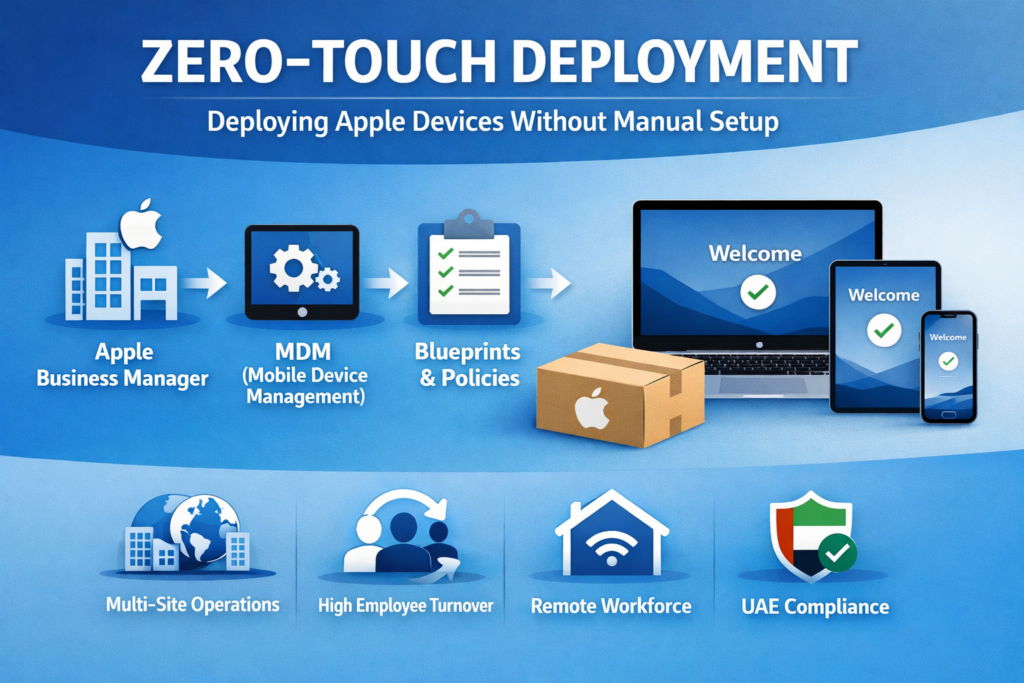
This matters even more inside the Apple ecosystem. With Apple Business (AB), an MDM can trigger what’s known as zero-touch deployment. In practice, an employee turns on a new Mac or iPhone, and the device configures itself. The company’s apps, Wi-Fi, and security policies are already applied before the employee even logs in.
Without an MDM, every update or issue depends on someone from IT stepping in manually, device by device. That’s why, as a company grows, an MDM stops being a nice-to-have. Instead, it becomes a core part of security, productivity, and the employee experience. In short, the bigger your Apple fleet gets, the more this kind of centralized control starts to pay for itself.
Jamf: the Apple-specialist option
Jamf Pro is one of the most recognized MDM platforms in the Apple ecosystem. Its exclusive focus on Mac, iPhone, iPad, and Apple TV allows for very deep integration with the operating system. In fact, it tends to adopt new Apple features before other vendors do.
Its main capabilities include the following:
- Zero-touch deployment for Mac, iPhone, iPad, and Apple TV.
- Blueprints, its declarative configuration management system.
- Smart Groups that group devices and users dynamically, with AI support.
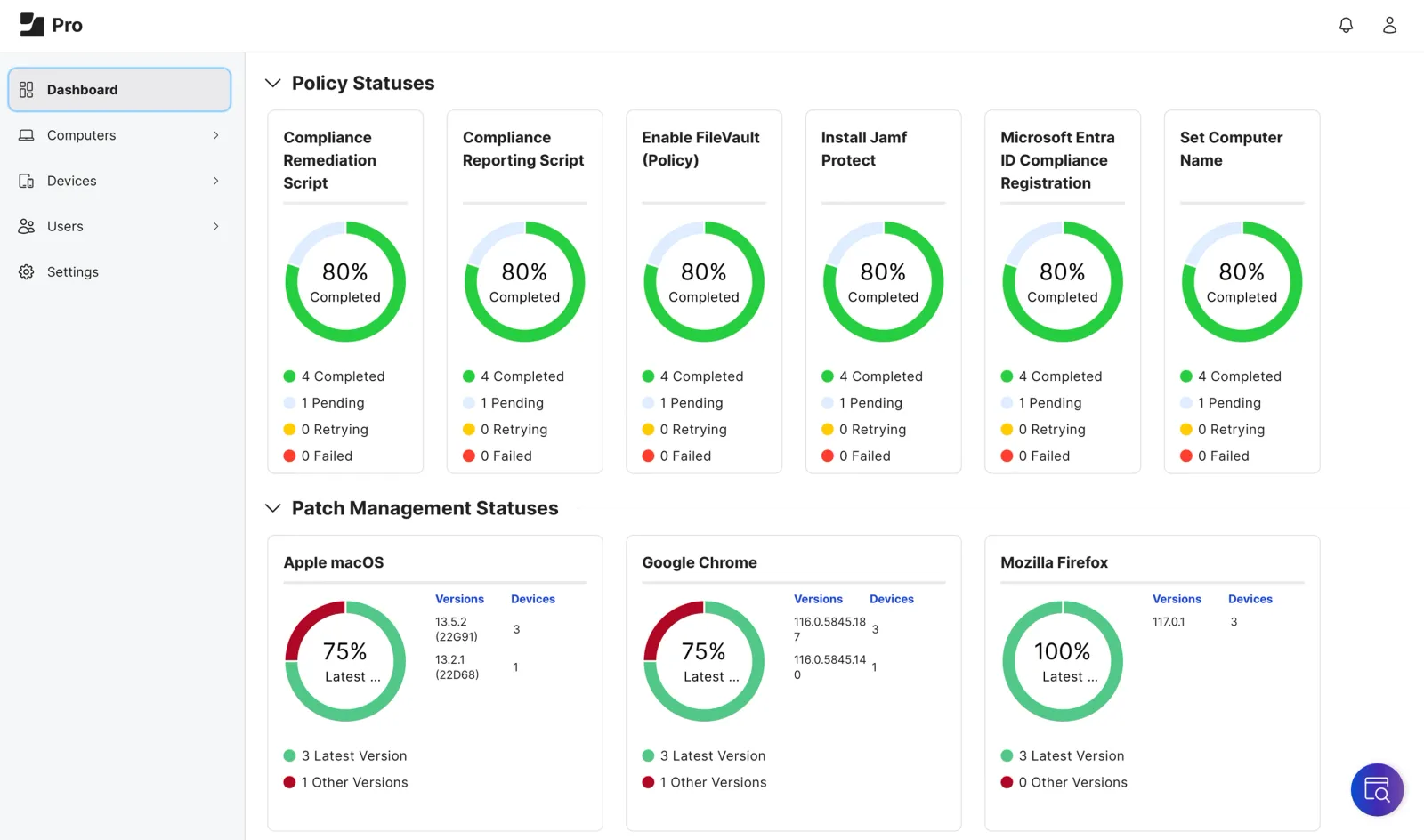
- Automated inventory of hardware, software, and security status.
- App lifecycle management, from distribution through updates.
- An AI assistant that gives instant support to IT and security teams.
- Integrations with Microsoft Entra, Power BI, Google Workspace, Okta, and other tools through the Jamf Marketplace.
Integration with the Apple ecosystem
Jamf is built from the ground up for Apple, without middle layers designed for other operating systems. As a result, companies that rely almost entirely on Mac, iPhone, and iPad tend to find Jamf the most mature option on the market. This is especially true for teams that want to adopt every new Apple feature quickly.
Pricing and licensing model
Jamf doesn’t publish fixed rates. Instead, pricing is quote-based, depending on the number of devices and the modules you need. This lets larger organizations tailor the cost to their needs. On top of that, it also means going through a sales process before you know the exact budget.
Hexnode: the cross-platform bet
Hexnode UEM starts from a different premise than Jamf or Mosyle: managing not just Apple, but virtually any device in the company from a single console. Its coverage includes Android, iOS, Windows, macOS, Linux, ChromeOS, Apple TV, Android TV, visionOS, and Fire OS.
Its standout features include:
- Zero-touch deployment, also available for Apple devices.
- Remote assistance to resolve issues without an on-site visit.
- Automated workflows that cut down repetitive IT tasks.
- Kiosk mode, useful in retail, logistics, or shared-use devices.
- Web filtering and geolocation, built for mobile device fleets.
- Advanced scripting and automation to customize device management.
Cross-platform support
This is where the real difference lies compared with Jamf and Mosyle. If your company mixes Mac and iPhone with Windows laptops or Android tablets, Hexnode avoids the need to maintain two or three separate management consoles. In exchange, its support for the very latest Apple features can lag slightly behind a specialist MDM.
Pricing and licensing model
Like Jamf, Hexnode doesn’t publish open pricing either. That said, it does offer a 14-day free trial, along with custom quotes based on device count and the features you need.
Mosyle: the unified, Apple-focused platform
Mosyle positions itself as an all-in-one suite for Apple. Rather than relying on separate tools, it combines device management, endpoint security, and identity in a single platform.
Its core capabilities include:
- Enterprise device management with automated remote tasks.
- Built-in endpoint security: antivirus, automated hardening, and an AI-driven Zero Trust approach.
- Native DNS filtering for iOS and macOS, without extra agents.
- Identity and SSO, with local account management and integration with enterprise identity providers.
- App and patch management, including operating system updates.
Integration with the Apple ecosystem
Like Jamf, Mosyle focuses exclusively on Mac, iPad, and iPhone. However, its differentiator lies in bundling security features that other MDMs would require a separate product for. As a result, it can simplify the tech stack for smaller companies or leaner IT teams.
Pricing and licensing model
Unlike Jamf and Hexnode, Mosyle does publish reference pricing. Business plans start at $1.00 per device per month, while education pricing starts at $0.46 per device per month. Both plans include onboarding and support, which makes it easier to compare budgets from day one.
Jamf vs Hexnode vs Mosyle: comparison table
| Criterion | Jamf | Hexnode | Mosyle |
|---|---|---|---|
| Platforms | Apple only (Mac, iPhone, iPad, Apple TV) | Cross-platform (Apple, Android, Windows, Linux, ChromeOS, and more) | Apple only (Mac, iPhone, iPad) |
| Built-in security | Compliance and declarative management | Web filtering, geolocation, kiosk mode | Antivirus, hardening, and Zero Trust included |
| Pricing transparency | Quote-only | Quote-only, with a 14-day trial | Public pricing from $1/device/month |
| Scalability | High, built for large Apple fleets | High, built for mixed device fleets | High, from startups to large enterprises |
| Best for | Apple-only companies that prioritize deep management | Companies with mixed devices (Apple + Windows/Android) | Apple companies that want security and management in one place |
Which one should you choose based on your company’s size and needs?
There’s no single winner among Jamf, Hexnode, and Mosyle. Instead, there’s the option that best fits your specific context.
If your company is 100% Apple, has an established IT team, and needs the highest level of customization, Jamf is usually the more robust choice. On the other hand, if your device fleet is mixed — Mac alongside Windows laptops, Android tablets, or in-store screens — Hexnode avoids duplicating management consoles. Finally, if you’re looking for a solution that’s Apple-focused, with built-in security and transparent pricing from the start, Mosyle tends to offer the most direct value for money. This is especially true for mid-sized companies or leaner IT teams.
Either way, the decision shouldn’t rest on a feature checklist alone. The regulations your industry faces, the level of support you need, and your company’s growth roadmap should all factor into the choice.
Common mistakes when choosing an MDM
Before deciding between Jamf, Hexnode, and Mosyle, it’s worth avoiding a few common mistakes we see in companies that switch MDMs more than once.
- Choosing on price alone. A cheap plan that doesn’t cover your security or support needs can end up costing more in the long run, especially in regulated sectors like finance or healthcare.
- Ignoring future growth. An MDM that works well with 50 devices can fall short at 500. For that reason, it’s worth asking about scalability limits from the start.
- Skipping migration planning. Switching MDMs without a clear plan can leave devices unmanaged for weeks. As a result, security risk spikes right during the transition.
- Forgetting to train the IT team. Still, the best tool delivers little value if no one knows how to use its advanced features.
Avoiding these mistakes is, in many cases, just as important as picking the right platform. In practice, a well-planned rollout of a mid-tier MDM often beats a rushed rollout of the “best” one on paper.
How Setek helps you choose and implement the right MDM
At Setek, we don’t sell a single MDM solution across the board. As an Apple Premium Technical Partner, we first assess your current infrastructure, your industry, and your business goals. Only then do we recommend Jamf, Hexnode, Mosyle, or whichever platform truly fits your situation.
Our device management consulting team handles the entire process. This includes setting up Apple Business Manager, zero-touch deployment, migrating from your current MDM if you already have one, and ongoing support. We also integrate device management with our cybersecurity services. This way, your Apple fleet’s protection doesn’t depend on a single tool, but on a complete strategy.
Comparing Jamf vs Hexnode vs Mosyle is the first step toward choosing well. However, the final decision depends on what your company looks like today and where you want to take it. Jamf stands out for its depth on Apple. Hexnode, on the other hand, excels at cross-platform reach. Mosyle, for its part, combines management and security in a single platform with clear pricing.
If you want to avoid a costly mistake, our team at Setek can review your specific situation. We’ll then recommend the MDM solution that best fits your company. Get in touch with our team, and let’s start by understanding your current infrastructure.
Key Takeaways
Key Takeaways
- Choosing between Jamf vs Mosyle vs Hexnode is crucial for companies using Apple devices, as each platform serves different needs and budgets.
- Jamf specializes in Apple devices with deep integration and advanced features, making it ideal for Apple-only environments.
- Hexnode offers cross-platform support, allowing management of various devices from a single console, beneficial for mixed-device fleets.
- Mosyle combines device management and built-in security features, providing clear pricing and value for mid-sized companies.
- When selecting among Jamf, Hexnode, and Mosyle, consider your company’s size, growth plans, and specific IT needs to avoid common missteps.
Estimated reading time: 9 minutes
What’s the main difference between Jamf, Hexnode, and Mosyle?
Jamf and Mosyle focus exclusively on Apple devices. Hexnode, on the other hand, also manages Android, Windows, and other systems from the same console. Mosyle, for its part, bundles endpoint security features that Jamf or Hexnode usually require extra tools for.
Hexnode does support Apple, including zero-touch deployment. However, because its development is split across several platforms, some Apple-specific features can take longer to roll out than in a specialist MDM like Jamf or Mosyle.
The cost depends on the number of devices and the features you choose. Mosyle publishes pricing starting at $1 per device per month. Jamf and Hexnode, on the other hand, require a custom quote.
Even with a small fleet, an MDM cuts down on manual setup time and improves security. Plus, the need grows the more your operation depends on those devices or the more regulated your industry is.