Cyberattacks are growing in volume, sophistication and impact. For businesses operating across Dubai, Abu Dhabi, Madrid and Barcelona, waiting for a real incident to discover where the security gaps are is no longer an acceptable strategy. The most effective way to find weaknesses before an attacker does is also one of the most established practices in cybersecurity: penetration testing — pentesting.
In this guide we explain what pentesting is, the different types and methodologies, how it fits into a modern security program, and how SETEK Consultants — Apple Premium Technical Partner — helps organizations across Spain, the UAE and the wider GCC turn pentesting from a one-off check into a continuous improvement engine.
What is pentesting?
Penetration testing is a controlled, authorized simulation of a real cyberattack against your systems, applications, networks, devices or people. The objective is simple: identify exploitable vulnerabilities — and prove they are exploitable — before a real attacker finds them.
Unlike automated vulnerability scanning, a pentest is conducted by skilled security professionals who combine tooling, manual techniques and creative thinking to chain weaknesses into realistic attack scenarios. The output is not just a list of issues, but a clear understanding of business risk, prioritized recommendations and the evidence to drive remediation.
International references such as NIST SP 800-115 (Technical Guide to Information Security Testing and Assessment), OWASP and the Penetration Testing Execution Standard (PTES) define the technical foundations of the practice.
Why pentesting matters today
Pentesting is no longer a “nice-to-have” — it is part of the cybersecurity baseline expected from any mature organization. The reasons are clear:
- Threat sophistication. Attackers combine phishing, credential theft, supply-chain abuse and zero-days in fast-moving campaigns.
- Regulatory pressure. Frameworks such as the UAE National Cybersecurity Strategy, ADHICS, the UAE PDPL, the GDPR, Spain’s Esquema Nacional de Seguridad and certifications like ISO 27001, SOC 2 and PCI DSS expect periodic technical testing.
- Cloud, mobile and hybrid sprawl. The attack surface keeps growing: SaaS, APIs, mobile devices, identity, OT/IoT and a fleet of Mac, iPhone and iPad.
- Business continuity. A single ransomware incident can cost more than years of preventive testing.
- Customer expectations. Clients, partners and investors increasingly require proof of security maturity.
Types of penetration testing
Different objectives require different testing approaches:
- Black box. The tester has no prior knowledge — closest to a real attacker’s perspective.
- Gray box. Limited knowledge or basic credentials, useful to simulate insider or post-compromise scenarios.
- White box. Full visibility (architecture, code, credentials), maximizing depth and coverage.
- External pentest. Targets the perimeter — public websites, APIs, VPN endpoints, exposed services.
- Internal pentest. Simulates an attacker who has already gained a foothold — lateral movement, privilege escalation, data exfiltration.
- Web and API testing. Focused on application-level vulnerabilities (referenced against the OWASP Top 10).
- Mobile and endpoint testing. Specific assessments for iOS and macOS workflows, MDM configurations, BYOD scenarios and Apple device fleets.
- Social engineering and phishing simulations. People-focused testing to validate awareness and process.
- Red Team engagements. Goal-oriented, multi-vector attacks simulating advanced threat actors over weeks or months.
- Wireless and physical testing. Wi-Fi (802.1X), badge cloning, on-site intrusion attempts.
- Cloud and identity assessments. AWS, Azure, Google Cloud, Microsoft Entra ID, Okta and Google Workspace.
The phases of a professional pentest
A well-run pentest typically follows these stages, aligned with NIST SP 800-115, PTES and the OWASP Testing Guide:
- Scoping and rules of engagement. Define targets, time windows, allowed techniques, escalation paths and legal authorizations.
- Reconnaissance. Open-source intelligence and passive discovery to map the attack surface.
- Threat modeling. Identify likely attacker objectives, paths and impacts.
- Vulnerability analysis. Combine automated scanning with manual validation.
- Exploitation. Demonstrate exploitability in a controlled, documented way.
- Post-exploitation. Lateral movement, privilege escalation, data access — within the agreed scope.
- Reporting. Executive summary, technical findings, evidence, prioritization and clear remediation guidance.
- Retesting and continuous improvement. Verify fixes and integrate lessons into your security roadmap.
Pentesting vs vulnerability scanning vs Red Team
These terms are often confused, but they cover different needs:
- Vulnerability scanning — automated, broad and frequent, ideal for continuous hygiene.
- Pentesting — manual, deep and targeted, ideal for validating exploitability and business impact.
- Red Team — adversarial, goal-oriented engagements that test detection and response capabilities of your Blue Team or SOC.
A mature security program uses all three, in the right rhythm.
Pentesting in Apple environments
For organizations standardized on the Apple ecosystem, pentesting must cover specific layers that are often overlooked:
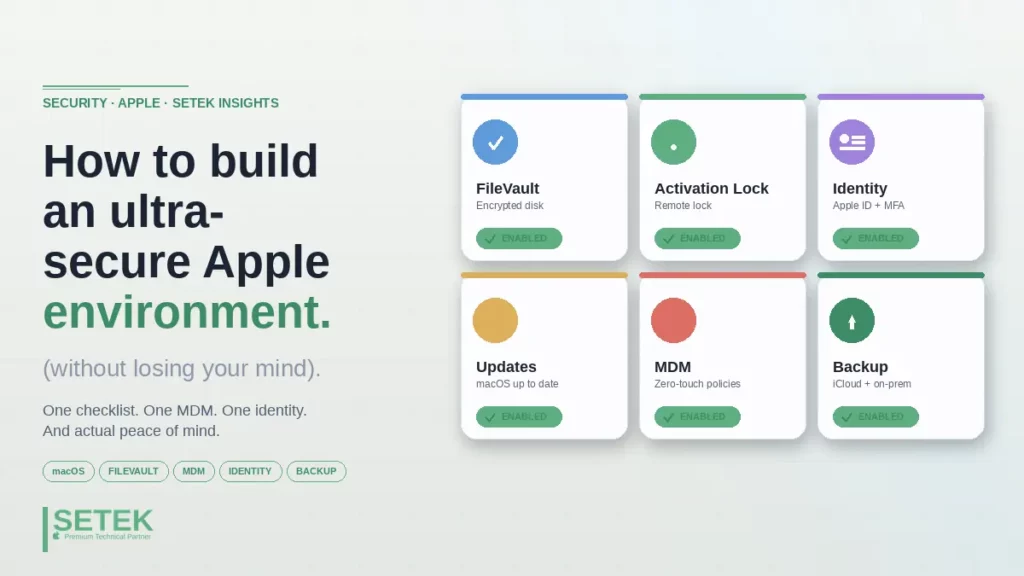
- macOS endpoint security. FileVault posture, system extensions, kernel-level protections, third-party agents.
- iOS and iPadOS configurations. Supervised mode, restrictions, configuration profiles, Managed Apple Accounts.
- MDM platform. Privilege levels, exposed APIs and integration with identity providers — see our overview of the best MDM solution for Apple businesses.
- Apple Business configuration. Roles, federation, content distribution and DEP/VPP integration.
- Wireless authentication. 802.1X, certificate distribution and roaming behavior across the corporate Wi-Fi.
- Identity and SSO. Microsoft Entra ID, Google Workspace or Okta, federation and conditional access.
For a deeper view of the threat landscape across Apple environments, read our analysis on how to protect your Apple devices in 2026 with cybersecurity, MDM and AI.
When to run a pentest
The right cadence depends on your risk profile, but the most common triggers are:
- At least once a year for any business handling sensitive data.
- After major changes — new applications, migrations, mergers, network re-architectures.
- Before certifications — ISO 27001, SOC 2, ENS, PCI DSS, ADHICS.
- After an incident to validate that the root cause has been addressed.
- As part of vendor due diligence when integrating critical third parties.
Common errors to avoid
Years of engagements across Spain and the UAE point to a consistent set of mistakes:
- Treating pentesting as a checkbox instead of a continuous improvement loop.
- Scoping too narrowly to “look good” — and missing the real risk.
- Failing to remediate findings before the next test.
- Not sharing executive summaries with leadership and the board.
- Confusing pentesting with vulnerability scanning.
- Skipping the human layer — phishing, vishing, smishing — where most breaches start.
Why this matters for businesses
In the UAE, regulatory expectations from authorities such as the Cybersecurity Council, the TDRA and sector-specific frameworks like ADHICS make periodic technical testing a baseline. In Spain, the Esquema Nacional de Seguridad, the GDPR and the EU’s NIS2 Directive push organizations toward continuous validation of their controls. For multinational organizations, a unified pentesting program across both regions is the most efficient way to demonstrate maturity to regulators, clients and investors.
At SETEK Consultants we combine Apple Premium Technical Partner credentials, deep cybersecurity expertise and proven managed services to design and deliver pentesting programs across Spain, the UAE and the wider GCC — from one-off assessments to continuous Red Team engagements integrated with your security roadmap. Discover how we have helped other organizations raise their security posture in our customer stories.
Don’t wait for an attacker to test your defenses — test them yourself first. Request your free consultation.