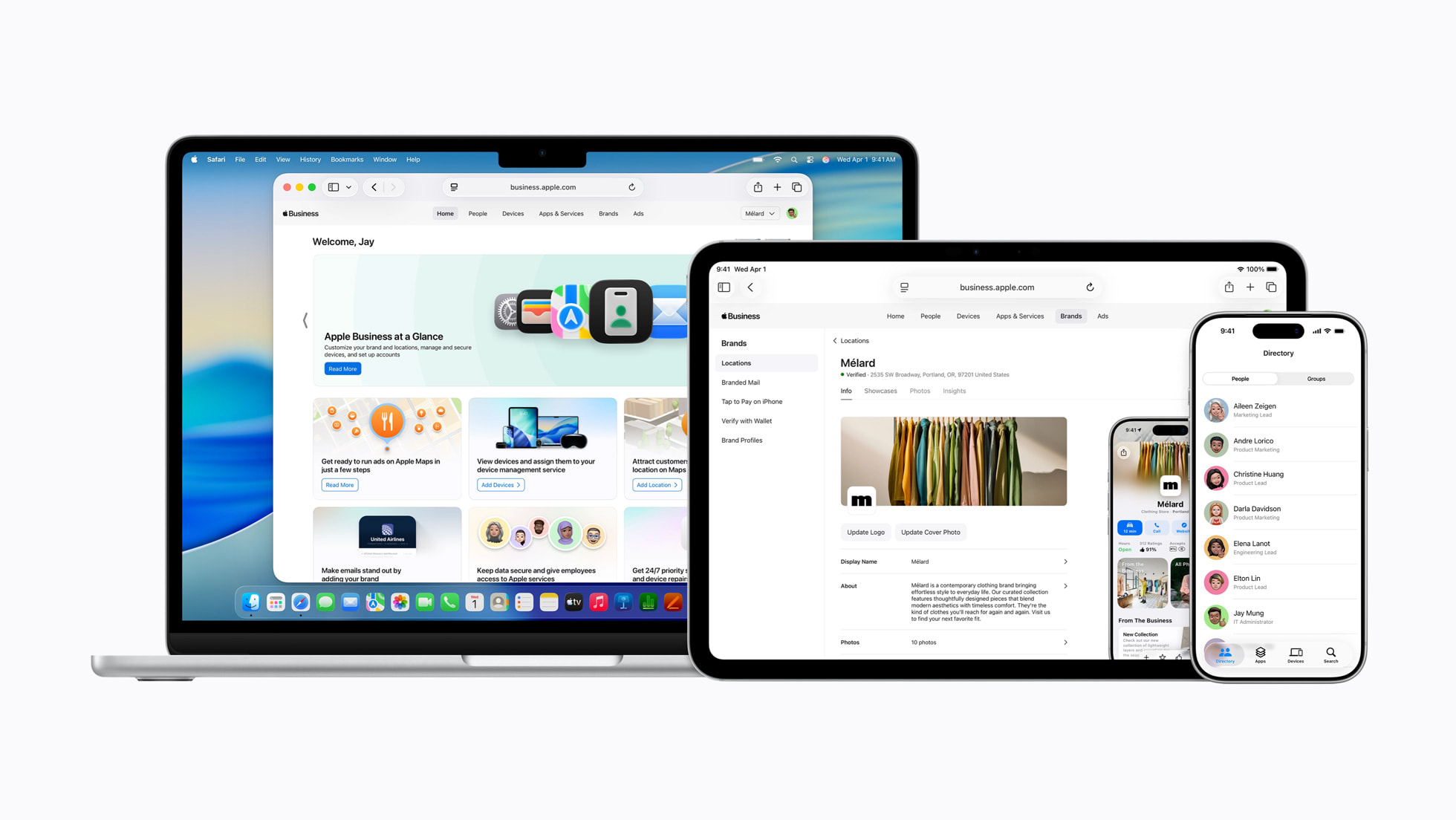
Apple Business is Apple’s new all-in-one platform that unifies device management, corporate email and calendar services, and brand presence tools in the Apple ecosystem into a single dashboard. It will be available globally from 14 April as a free service for companies that previously used Apple Business Manager, Apple Business Essentials or Apple Business Connect.
Apple Business includes at a functional level:
Integrated Mobile Device Management (MDM) with a unified console for the entire Apple fleet.
Email, calendar and directory services with your own domain, or one acquired directly from the platform.
Branding and location tools to control how the company appears in Maps, Wallet, Mail, Safari and other services.
Key IT news: integrated management and Blueprints
Until now, many SMEs needed to combine Apple Business Manager with a third-party MDM solution and manual processes to cover the entire device lifecycle. Apple Business takes a step further by integrating MDM capabilities directly into the platform, simplifying the IT department’s view.
One of the most interesting points is Blueprints: templates that allow pre-defining apps, settings and policies by role or team, and applying those configurations without user intervention when the device is first switched on. For organisations with distributed teams or no local IT, this reduces deployment time, configuration errors and support tickets.
Apple Business introduces email, calendar and directory services designed to give a solid corporate identity to businesses that may currently work with generic accounts. The platform allows using an existing domain or registering a new one from within the Apple Business environment.
From a productivity perspective, the advantage lies in integration: calendar delegation, integrated directory with employee profiles and groups, and the ability to combine it with Managed Apple Accounts linked to identity providers like Google Workspace or Microsoft Entra ID.
Brand, customers and phygital experience
Another important change: Apple brings Apple Business Connect functions into Apple Business, reinforcing the local marketing and customer experience layer. From a single dashboard, the company can manage name, logo, photos, opening hours, calls to action and location listings that will appear in Apple Maps, Safari, Spotlight, Wallet and other services.
Additionally, Apple Business allows: highlighting offers or campaigns directly in Maps listings; adding actions like “buy” or “book” that take the user to the company website or app; consulting statistics on how customers find and use those listings; integrating the brand in Mail and order tracking in Wallet.
From Setek Consultants’ experience implementing Apple environments with advanced MDM (Jamf, Hexnode, etc.), we see three clear lines of work: architecture review — analysing how Apple Business fits with the current MDM solution; governance and identity — defining a model of Managed Apple Accounts, domains and directories; and local marketing — leveraging the new branding and analytics tools.
Well planned, Apple Business is not just a console change, but an opportunity to rationalise Apple environment management and better connect with customers who already live in the Apple ecosystem.
Do you need help, contact us and start Apple Business right from day one